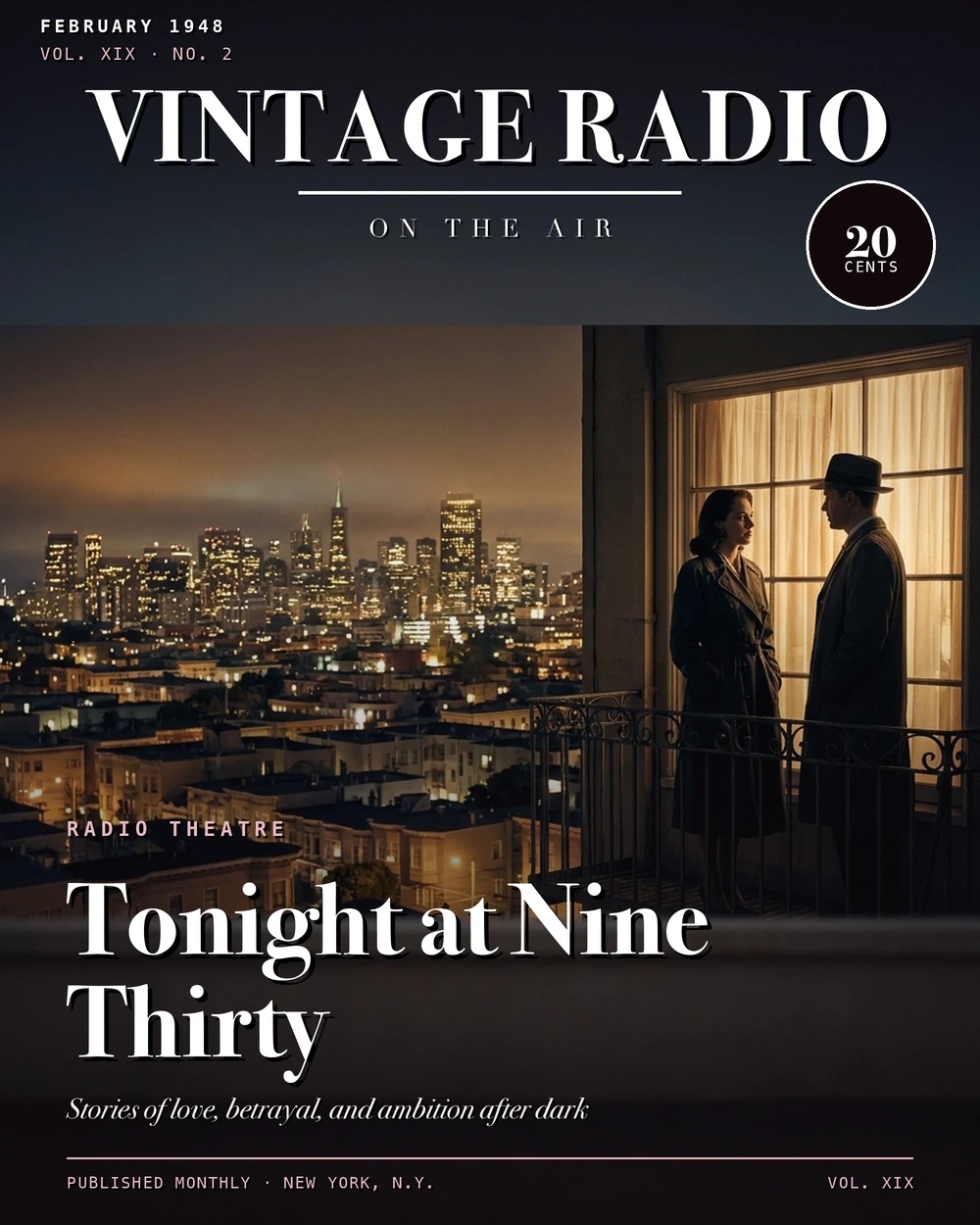
Tonight at Nine Thirty
A West Coast Anthology with Its Own Personality
Tonight at Nine Thirty came out of KPO in San Francisco, NBC's owned flagship station on the West Coast — a 50,000-watt operation on 680 kHz that served as the hub of NBC's San Francisco radio network during the 1940s. The show ran from at least January 5, 1945 through February 26, 1946, and it drew on local writing and acting talent from a city that had a serious claim to being one of the best theater towns in the country. That theatrical connection showed up in the casting — the ensemble featured some of the best stage performers working in San Francisco at the time.
What set the show apart from the radio drama landscape of its day was its structure. Rather than following a continuing cast through serialized storylines, each episode presented a self-contained story, complete from opening to close. The range was wide: suspenseful thrillers, lighthearted comedies, domestic dramas. The show has been described as putting a twist on the conventional soap opera format — broader in scope, more varied in tone, and aimed at a nighttime audience that expected something a little more substantial.
The Stage Door Keeper
Every episode opened the same way: a recurring host character called the Stage Door Keeper, described as an old man who offered a brief introduction before the story began. He was also known to digress — wandering off into the history of the San Francisco theater scene before getting around to the evening's tale. It was a small but distinctive touch, giving the show a sense of place and personality that purely formulaic productions didn't bother with. The Stage Door Keeper grounded the anthology in a specific city and a specific world, even as the stories themselves roamed across genres.
The production leaned into its theatrical roots in other ways too. Live sound effects and rich soundscapes were central to how the show built atmosphere, and each episode was written from an original script rather than adapted from existing material. Themes of love, betrayal, and ambition recurred across the run, though individual episodes pushed into more specific territory — one dealt with a family working through the aftershocks of a long-held secret, while titles like "The Black Market Murders," "The Ghost of the House of Ingar," and "The Devil Is a Woman" suggest the show wasn't shy about leaning into genre storytelling when the script called for it.
What Survives
Ten episode titles are documented in the catalog — "The Revolution," "Nervous Indigestion," "The Devil Is a Woman," "By Rocks and Rills," "The Return Of The Blauden," "The Comic Strip," "The Ghost of the House of Ingar," "Gastus Strom," "The Black Market Murders," and "The Road To Decosel." That range alone says something about how much ground the show covered in a single run: folk drama, crime, the supernatural, character comedy. Listings of surviving recordings point to a slightly larger body of audio still in circulation than the catalog itself preserves by name.
The show ran for roughly fourteen months before its final broadcast on February 26, 1946. As a West Coast production that never appears to have gone national, Tonight at Nine Thirty operated below the radar of the major network showcases centered in New York and Chicago. What it left behind is a small but varied body of work that reflects the ambition of local radio production during the mid-1940s — a drama series that treated San Francisco's theatrical community as a genuine creative resource rather than a backup option.